Our take
Agtonomy's bet is software inside major brands' machines rather than selling its own robot. That puts it closer to an OEM autonomy stack than to Burro's standalone fleet.2,3
An $18 million Series B in October 2025, led by DBL Partners with Nuveen joining, points to commercial traction with growers and land managers.3
Scores by criterion
Each criterion is defined on our methodology page.
Who uses Agtonomy and what it's for
Orchard, vineyard, and specialty-crop growers use Agtonomy-enabled Kubota and Bobcat machines for mowing, spraying, hauling, and related fieldwork.2,4
Land-management and turf operators are part of the company's expansion beyond core agriculture.3
History
Tim Bucher founded Agtonomy in 2021 with a team of growers and technologists. The company is based in South San Francisco and focuses on the western United States.2,3
On October 28, 2025 it closed an $18 million Series B led by DBL Partners, with Nuveen and existing investors Autotech, Allison Transmission, Rethink Food, and Black Forest Ventures participating.3
Factory-integrated autonomy
Agtonomy's software is built into partner equipment at the factory. Operators plan jobs, dispatch machines, and monitor fleets in one app, with support for hundreds of implements.1,2
Kubota has expanded Agtonomy-enabled M5N and M5L tractor pilots for specialty crops, and Bobcat CT4045 is among the supported platforms.4,5
Pricing
Agtonomy does not publish end-customer robot prices. Pricing is tied to OEM equipment packages and software services sold with those machines.1,2
Competitive landscape
| Company | Product | Pricing model | Deployment footprint | Where Agtonomy wins or loses |
|---|---|---|---|---|
| Agtonomy | Factory-integrated autonomy software for partner equipment2 | Sold with OEM machine packages; end prices not published1 | Western US specialty crops, turf, and land management2 | Autonomy built into major OEM tractors rather than a standalone robot |
| Burro | Autonomous platforms for towing, hauling, mowing, spraying, and patrolling6 | Not published; sold direct and through 50 dealers6 | More than 800 robots in 17 countries; 1 million autonomous hours6 | Burro wins on its own robots working beside crews at scale. Agtonomy wins on autonomy inside major tractor brands. |
| Bonsai Robotics | Bonsai Intelligence autonomy for its Amiga platform and partner machines12 | Not published on its site13 | Specialty crops in the United States and Australia12 | Bonsai wins on orchard spraying autonomy. Agtonomy wins on multi-implement OEM factory integration. |
| Naïo Technologies | Oz, Ted, Jo, and Orio robots for weeding, seeding, and vineyard work9 | Not published on its site9 | 40 certified partners in more than 20 countries9 | Naio wins on dedicated weeding robots in Europe. Agtonomy wins on software inside conventional equipment. |
| Saga Robotics | Thorvald robots that treat mildew with UV-C light and count fruit11 | Not published on its site11 | Strawberries and grapes in the US, UK, and Norway10 | Saga wins on UV-C disease control. Agtonomy wins on broader fieldwork automation via OEMs. |
Limits
End-user prices are not published on Agtonomy's site.1
Buyers must purchase supported OEM equipment; Agtonomy is not a standalone robot fleet like Burro.2
Revenue is not disclosed. Third-party estimates cluster around $17 million to $30 million annually, with roughly 70 employees. This is an estimate, not a reported figure.3
What customers say
Where it helps
Growers already buying Kubota or Bobcat specialty equipment get the cleanest path to Agtonomy autonomy.4,5
Operators who want one app across multiple machines and implements match Agtonomy's fleet workflow.1
Where it falls short
Growers who want a robot that works beside crews without buying a new tractor brand should look at Burro, and orchard spraying specialists may prefer Bonsai Robotics.
Leadership
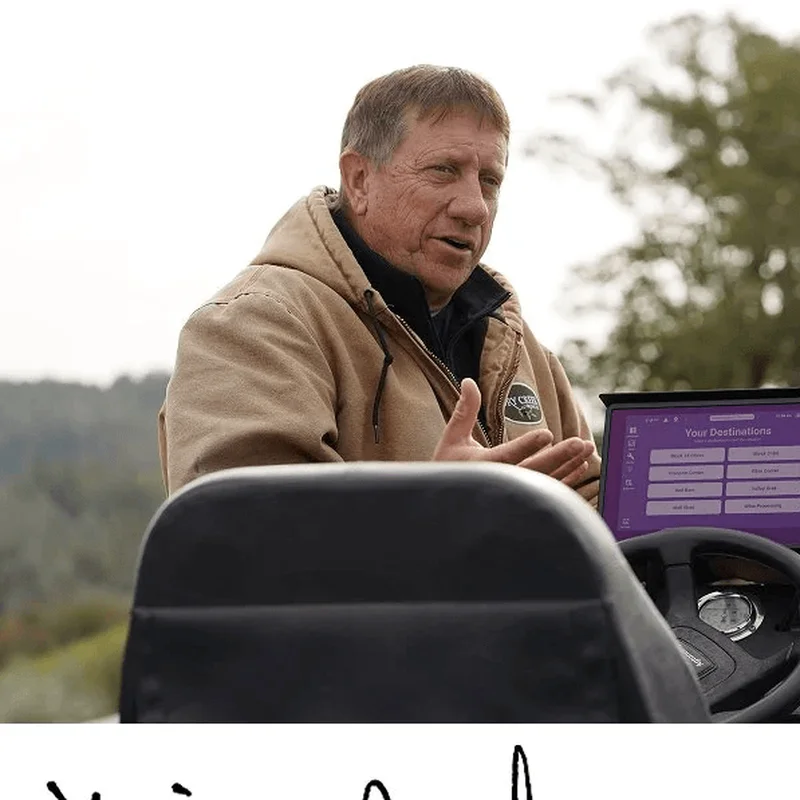
Tim Bucher
Founder and CEOBucher founded Agtonomy in 2021 and leads its physical AI software for off-road equipment makers.3,2
Sources
- Agtonomy, Homepage, accessed November 5, 2026
- Agtonomy, About us, accessed November 5, 2026
- Agtonomy, Agtonomy secures $18 million Series B, October 28, 2025, accessed November 5, 2026
- Agtonomy, FAQ, accessed November 5, 2026
- Kubota USA, Kubota expands autonomous solutions and introduces the M5L tractor for specialty crops, accessed November 5, 2026
- GlobeNewswire, Burro announces general availability of Grande 44, now shipping to customers, October 20, 2026, accessed November 4, 2026
- Technical.ly, The Philly company that makes autonomous farm robots just raised $24M, January 2024, accessed November 4, 2026
- Business Wire, Bonsai Series A, accessed November 6, 2026
- Naïo Technologies, Homepage, accessed November 4, 2026
- Saga Robotics, About, accessed November 4, 2026
- Saga Robotics, Homepage, accessed November 4, 2026
- Bonsai Robotics, About, accessed November 6, 2026
- Bonsai Robotics, Homepage, accessed November 6, 2026