Our take
Flexiv is one of the most technically distinctive arm makers we have reviewed. Instead of following fixed motion paths, its Rizon arms sense force through every joint, so they can sand, polish, and insert parts that a standard cobot would need fixtures and careful tuning to handle.1,5
It is also larger and better funded than most companies in our range, with about 400 staff and two funding rounds of about $100 million or more. The weak spot for buyers is pricing: Flexiv publishes none, and most systems are sold as turnkey solutions through integrators.4,3
Scores by criterion
Each criterion is defined on our methodology page.
Who uses Flexiv and what it's for
Manufacturers in automotive, electronics, and precision assembly use Flexiv arms for contact-rich work such as polishing, adhesive priming, and fitting flexible parts, and the company also sells into agriculture, hospitality, and research.1,4,5
Robotics researchers and AI teams use the Rizon 4, which is now supported in NVIDIA Isaac with a contact-rich insertion workflow.1
History
Flexiv was founded in Santa Clara in 2016 by a team from Stanford University's robotics and AI lab, and opened its China headquarters in Shanghai two years later as its main R&D and operations center.2,4
It raised a Series B of more than $100 million in December 2020, a Series C of about $100 million in June 2025, and a further round led by Invus in March 2026. China named it a national 'little giant' specialized enterprise in 2025.5,4,3
Adaptive robots
The Rizon series are 7-axis arms with joint torque sensing across the whole arm, which lets them control contact force, work safely near people, and adapt to variation in parts. Rizon has been the commercial flagship since 2022, and newer platforms called Enlight and MICO debuted overseas in 2026.5
Flexiv's portfolio now also spans grippers, AMR platforms, and delta robots, and it runs a global repair center in Hong Kong for overseas customers.3,4
Scale and revenue
Flexiv has about 400 employees, 200 of them at its Shanghai R&D center, and does 30% to 40% of its business overseas. It has offices or business centers in San Jose, Shanghai, Beijing, Shenzhen, Foshan, Munich, and Singapore.4,2
Revenue is not published. China Robotics Insider puts 2025 revenue at about RMB 500 million, roughly $70 million, after two to three times growth a year since 2022. This is an estimate, not a reported figure.5
Competitive landscape
| Company | Product | Pricing model | Deployment footprint | Where Flexiv wins or loses |
|---|---|---|---|---|
| Flexiv | Rizon 7-axis force-controlled adaptive arms, plus grippers, AMRs, and delta robots3 | Not published; sold direct and through integrators1 | About 400 staff; 30% to 40% of business overseas4 | Whole-arm force control for contact-rich work |
| Universal Robots | Collaborative robot arms with payloads up to 35 kg and PolyScope X software6 | Not published on its site6 | More than 100,000 cobots sold worldwide6 | Universal Robots wins on a huge installed base and partner ecosystem. Flexiv wins on force control through the whole arm. |
| Kinova | Robot arms for assistive, professional, and medical uses, made in Canada8 | Not published on its site8 | Partnerships in more than 45 countries8 | Kinova wins on lightweight arms for assistive and research use. Flexiv wins on industrial force-controlled processes. |
| Agile Robots | Force-sensitive robot arms, humanoids, and automation systems9 | Not published on its site9 | More than 2,000 R&D staff; customers in automotive, electronics, and healthcare9 | Agile Robots wins on scale and a broader product line. Flexiv wins on a focused adaptive arm lineup. |
| JAKA Robotics | Zu, S, A, AL and Mini cobots plus embodied AI robots10 | Zu 5 listed at $31,300 by a reseller11 | RMB400.43M revenue in 202412 | JAKA wins on lower prices and volume. Flexiv wins on force control through the whole arm. |
| Neuromeka | Indy cobots, industrial cobots, delta robots and AMRs14 | Indy7 at EUR23,400 excl. VAT from a marketplace13 | KRW18.95B revenue in 202515 | Neuromeka wins on lower list prices in Korea and Europe. Flexiv wins on force-controlled processes. |
Limits
Prices are not published, and buyers usually go through a sales team or system integrator.1
Force-controlled arms take more application engineering than a basic pick-and-place cobot, so simple tasks may not need the extra capability.5
Revenue figures come from a third-party estimate, not company filings.5
What customers say
Where it helps
Flexiv fits work that has resisted automation because parts vary or the task depends on touch, such as polishing a casting, priming a car part with adhesive, or inserting a wire harness connector.1,4
Its force control also suits labs and AI teams that need a capable research arm with simulation support.1
Where it falls short
Factories that only need standard pick-and-place or palletizing can usually buy a simpler, cheaper cobot, and shops that want a robot welding cell sold with a published price should look at Hirebotics.
Leadership
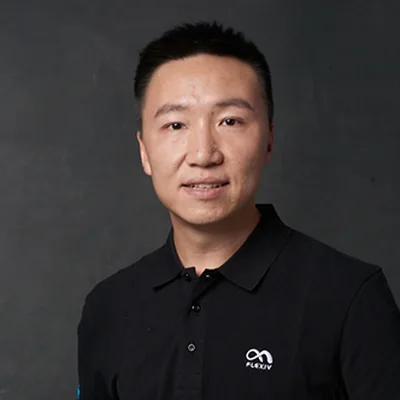
Wang Shiquan
Co-founder and CEOWang co-founded Flexiv in 2016 after a Stanford PhD in mechanical engineering and leads its global expansion.3,4
Sources
- Flexiv, Homepage, accessed November 4, 2026
- Flexiv, About, accessed November 4, 2026
- Flexiv, Flexiv secures capital from leading evergreen investor to scale global deployment of adaptive robots, March 18, 2026, accessed November 4, 2026
- HKTDC Research, Self-developed adaptive robot unicorn looking to go global, accessed November 4, 2026
- China Robotics Insider, Flexiv company profile, accessed November 4, 2026
- Universal Robots, Homepage, accessed November 5, 2026
- Canadian Trade Commissioner, Kinova story, accessed November 5, 2026
- Kinova, Homepage, accessed November 5, 2026
- Agile Robots, Homepage, accessed November 5, 2026
- JAKA Robotics, Homepage, accessed November 9, 2026
- Triple Automation, JAKA Zu 5, accessed November 9, 2026
- JAKA, STAR Market prospectus, accessed November 9, 2026
- Unchained Robotics, Neuromeka Indy7, accessed November 9, 2026
- Neuromeka, Homepage, accessed November 9, 2026
- DigitalToday, Neuromeka 2025 results, accessed November 9, 2026
- Universal Robots, Gen 7 platform, accessed November 16, 2026
- Mekawire, Teradyne's robotics arm shrinks 16% to $308 million in 2025, accessed November 16, 2026