Our take
VisionNav has the broadest autonomous forklift range in this group, including reach trucks for high-bay racking and truck loading and unloading.1
It sells mostly through system integrators, so buyers deal with a local partner for design and support.3
Scores by criterion
Each criterion is defined on our methodology page.
Who uses VisionNav and what it's for
Warehouses and factories automating pallet moves, high-bay put-away, stacking and truck loading.1
Integrators building mixed fleets of autonomous trucks under one control system.1,3
History
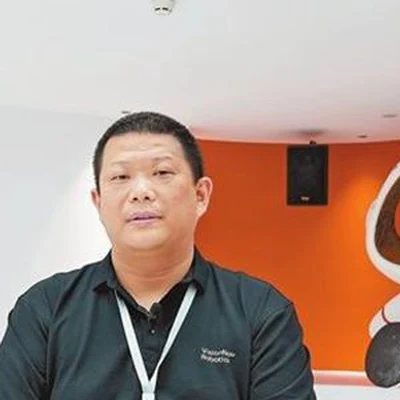
VisionNav was founded in Shenzhen in 2016 by PhDs mainly from the Chinese University of Hong Kong. Li Luyang is co-founder and chief executive, and the company now lists Atlanta as its headquarters.4,2
In April 2022 it raised RMB500 million (about $76 million) in a Series C extension led by Meituan and 5Y Capital at a valuation above $500 million. It reported 2021 sales of RMB200 million to RMB250 million.3
Autonomous industrial trucks
The range covers VNP counterbalance stackers, VNE counterbalance trucks, VNR reach trucks, VNST slim forklifts, VNT pallet jacks, VNQ tuggers and VNK mobile robots, all run by its Robot Control System.1
VisionNav lists more than 500 staff, 70% of them in R&D, and more than 800 deployed projects in over 30 countries.2
Pricing
VisionNav quotes projects through demos and integrator proposals.1
Its executives have said China-based manufacturing gives it a price advantage over Western rivals.3
Competitive landscape
| Company | Autonomous truck product | Pricing model | Deployment evidence | Where VisionNav wins or loses |
|---|---|---|---|---|
| VisionNav Robotics | Autonomous counterbalance, reach, stacker, pallet jack and tugger trucks1 | Quote-based through integrators3 | More than 800 projects in over 30 countries2 | Widest autonomous truck range including reach trucks |
| BALYO | VEENY VNA to 17 m, REACHY, LOWY stackers, and TUGGY tugger on OEM chassis13 | Not published; quote after mapping and simulation13 | More than 2,000 robots deployed; use cases do not name customers19 | BALYO wins on high-bay storage to 17 m on standard OEM trucks. VisionNav wins on the widest range of autonomous truck types. |
| Fox Robotics FoxBot ATL | Autonomous counterbalance forklift for trailer loading and unloading17 | Not published17 | 25 customers, mostly pilots, including Walmart16 | FoxBot wins on trailer loading and unloading with no WMS project. VisionNav wins on the widest range of autonomous truck types. |
| Vecna Robotics | CaseFlow and autonomous pallet jacks and tuggers6 | Quote only; Robots as a Service offered11 | Distribution centers such as GEODIS sites11 | Vecna wins on pairing robots with human case pickers, with RaaS terms. VisionNav wins on the widest range of autonomous truck types. |
| Seegrid | Autonomous tow tractors and lift trucks5 | Not published5 | More than 20 million customer miles5 | Seegrid wins on a long record in tow and pallet moves. VisionNav wins on the widest range of autonomous truck types. |
| AGILOX | ONE, OFL, OCF and ODM autonomous forklifts and AMRs8 | Purchase, lease, rental or per-hour Movement as a Service9 | More than 2,000 units at Siemens, BMW, Bosch and Daimler9 | AGILOX wins on server-free swarm control and flexible financing. VisionNav wins on the widest range of autonomous truck types. |
Limits
Manufacturing and R&D sit in China, which can stretch lead times for spares elsewhere.3
Design and support run through the local integrator.3
Its Atlanta headquarters is newer than its Shenzhen engineering base.2,4
What customers say
Where it helps
Sites that need high-bay reach trucks or truck loading automation get the most from VisionNav.1
Buyers wanting one supplier for several truck types benefit from the range.1
Where it falls short
Buyers who want a server-free swarm in narrow aisles should look at AGILOX; buyers focused on tow trains should look at Seegrid.
Leadership
Sources
- VisionNav Robotics, Homepage, accessed November 9, 2026
- VisionNav Robotics, Company, accessed November 9, 2026
- TechCrunch, VisionNav raises $76M at $500M valuation, April 29, 2022, accessed November 9, 2026
- Futian District Government, VisionNav Robotics story, accessed November 9, 2026
- Seegrid, Home page, accessed November 1, 2026
- Vecna Robotics, Home page, accessed November 1, 2026
- AGILOX, Company, accessed November 9, 2026
- AGILOX, Homepage, accessed November 9, 2026
- AGILOX, Financing, accessed November 9, 2026
- BizData, AGILOX annual accounts 2025, accessed November 9, 2026
- Vecna Robotics, Vecna Robotics raises $31 million to meet demand for flexible dock-to-dock automation, September 10, 2026, accessed October 31, 2026
- BALYO, Use cases, accessed November 9, 2026
- BALYO, homepage and autonomous forklift range, accessed November 9, 2026
- BALYO, BALYO announces its 2025 results, March 16, 2026 (PDF), accessed November 9, 2026
- Autorite des marches financiers, BALYO squeeze-out implementation notice, April 9, 2026 (French PDF), accessed November 9, 2026
- The Robot Report, Symbotic acquires autonomous forklift maker Fox Robotics, 2026, accessed November 9, 2026
- Fox Robotics, FoxBot ATL product page, accessed November 9, 2026
- Fox Robotics, homepage, accessed November 9, 2026
- BALYO, About us, history, executive committee, and offices, accessed November 9, 2026